Showing posts with label Tourism. Show all posts

Wednesday, 20 January 2016

International tourists hit record 1.2 billion in 2015, says UNWTO


By Karla Cripps, CNN


According to the UN World Tourism Organization (UNWTO), a record-breaking 1.2 billion tourists traveled abroad in 2015. Europe, the Americas, Asia and the Pacific all recorded about 5% increases in international arrivals.


(CNN)Here's a staggering figure to consider next time you're grumbling about the long lines at the airport check-in counter: 1.184 billion.
That's how many tourists traveled outside their countries' borders for at least one night in 2015, according to new record-breaking stats released by the United Nations World Tourism Organization (UNWTO) in its latest World Tourism Barometer.
It's a rise of 4.4% -- or 50 million -- over 2014 and the 6th consecutive year of above-average growth, said the report.
"The robust performance of the sector is contributing to economic growth and job creation in many parts of the world," said UNWTO Secretary-General Taleb Rifai, in a statement.
"It is thus critical for countries to promote policies that foster the continued growth of tourism, including travel facilitation, human resources development and sustainability.


Why the continued demand?

    By region, Europe, the Americas and Asia and the Pacific all recorded around a 5% increase in international arrivals in 2015, said the report.
    Europe led the way, supported by a weaker euro against the U.S. dollar and other main currencies, with arrivals reaching 609 million -- 29 million more than in 2014.
    Asia and the Pacific, also at 5%, recorded 13 million more international tourist arrivals last year to reach 277 million, with uneven results across destinations.
    International tourist arrivals in the Americas grew 9 million to reach 191 million.
    "The appreciation of the U.S. dollar stimulated outbound travel from the United States, benefiting the Caribbean and Central America, both recording 7% growth," said the report.
    "Results in South America and North America (both at 4%) were close to the average."
    Arrivals to the Middle East increased by 3% while Africa (though limited data was available) experienced an estimated 3% decrease -- "mostly due to weak results in North Africa, which accounts for over one third of arrivals in the region."
    All the usual factors came into play for this mixed bag of results.
    Exchange rate fluctuations and drops in oil and other commodities' prices increased disposable income in importing countries but weakened demand in exporting nations, said the World Tourism Barometer.
    Increased safety and security concerns were also a factor.


    So who's traveling?

    In 2015, China continued to lead global outbound travel, pouring cash into Asian destinations such as Japan and Thailand, as well as the United States and various European destinations, said the report.
    "By contrast, expenditure from the previously very dynamic source markets of the Russian Federation and Brazil declined significantly, reflecting the economic constraints in both countries and the depreciation of the ruble and the real against virtually all other currencies."

    More of the same in 2016

    For those hoping to enjoy less crowded flights in the months to come, sorry to break it to you. Your odds of getting a row of seats to yourself aren't going to improve in 2016.
    The UNWTO Confidence Index says that while growth will be slightly lower than in the previous two years, international tourist arrivals are predicted to increase by 4% worldwide in 2016.
    By region, growth is expected to be strongest in Asia and the Pacific (4%-5%) and the Americas (4%-5%), followed by Europe (3.5%-4.5%).
    "The projections for Africa (2%-5%) and the Middle East (2%-5%) are positive, though with a larger degree of uncertainty and volatility," said the Index.

    Tuesday, 12 January 2016

    India Mumbai identifies 'no selfie' zones after woman dies

    Mumbai selfie couple
    Selfie warnings will be put in Mumbai's iconic Marine Drive promenade. AFP
    BBC: Police in the Indian city of Mumbai have identified 15 places where taking selfies "can be dangerous".
    The places include the iconic sea-facing Marine Drive promenade and the popular Girgaum Chowpatty beach, both major tourist attractions.
    The decision was taken after an 18-year-old girl drowned in the sea while taking a selfie last week.
    Last year, authorities imposed a "no selfie zone" at a Hindu festival due to fears they could cause stampedes.
    Signs saying "no selfie zone" can be seen around the two festival sites in the city, which is the capital of Maharashtra state.
    Mumbai police spokesperson Dhananjay Kulkarni told the BBC that the places where taking selfies was risky included Bandra Bandstand, Sion Fort and Worli Fort, all places popular with tourists.
    "The police will now approach the city's municipality to prevent accidents at such spots due to people taking selfies. The municipality may deploy life guards and install warning signs," Mr Kulkarni said.
    The police warning follows Saturday's incident when three girls trying to take a selfie near the sea in the Bandra area fell into the water.
    One of them drowned and her body is yet to be recovered.
    A passerby, 37-year-old Ramesh Walanju, jumped in and helped save the other two girls but was washed away by the choppy waters and his body was found floating in a nearby creek on Monday, AFP said.
    Mumbai selfie
    Most of the selfie warnings will come up at the city's tourist attractions AFP
    In September a Japanese tourist died after allegedly slipping down the stairs while taking a selfie at the Taj Mahal monument in Agra.
    Last year, the Russian government reportedly launched a campaign to make young people think twice before snapping selfies in risky situations.
    In May, a 21-year-old woman survived accidentally shooting herself in the head while posing for a selfie with a gun in Moscow. There have also been several cases of children being electrocuted while taking selfies on top of railway carriages in Russia.
    In August, a man in Spain was gored to death by a bull while taking a selfie at the annual bull running festival in the town of Villaseca de la Sagra.
    http://www.bbc.com/news/world-asia-india-35289536

    Friday, 18 September 2015

    Should Selfie be banned, because of its lethal consequences, or should tourists be educated for their behavious?


    By 

    A Tourist dies at India's Taj Mahal ‘while taking a selfie’. A Japanese man has died from a heart attack after reportedly falling down the stairs of the historic Unesco World Heritage monument

    Tourist dies at India's Taj Mahal ‘while taking a selfie’
    India's Taj Mahal monument is said to be packed with up to 60,000 visitors a day Photo: Fotolia/AP

    Sixty six-year-old Hideto Ueda was said to have been taking a 'selfie' at the Taj Mahal’s Royal Gate, Sagar Singh, a local witness told the BBC.
    Mr Ueda was accompanied by three other people and a local guide when he collapsed after climbing up the stairs of the white marble tomb and fell, Sushant Gaur, an officer at the local police station in Agra, told the AFP.
    “He was rushed in an ambulance to the hospital but he could not be revived.
    "A post mortem was carried out and the cause of death is heart attack. We have duly informed the Japanese embassy about the unfortunate incident " Susant Gaur told the AFP

    Tourist dies at India's Taj Mahal ‘while taking a selfie’
    A train in Andhra Pradesh, India  Photo: Fotolia/AP
    One of Mr Ueda’s colleagues was said to have suffered a fractured leg after they both fell from the staircase, the police said.
    A further investigation is being launched into the incident.
    The recent death at the Taj Mahal, India's fabled mausoleum which is said to be packed with up to 60,000 visitors a day, is the latest in a series of selfie-related deaths and injuries that have occurred this year, including that of three young men who were killed in India in January by a speeding train as they posed for reckless selfies on the train tracks.
    Earlier this month, a Melbourne student was thought to have fallen to her death after losing her balance while attempting to take a selfie at Norway’s Trolltunga rock which juts out 700 metres above Lake Ringedalsvatnet.
    Tourist dies at India's Taj Mahal ‘while taking a selfie’
    In August, a man in Villaseca de la Sagra, Spain died after being gored in the neck from behind while trying to capture the annual bull run there on his mobile phone.
    Back in July, a woman was gored by a bison at Yellowstone National Park while attempting to take a selfie near the bison. The 43-year-old Mississippi woman was the fifth Yellowstone visitor since May to be gored by one of the park's popular bison, which can weigh as much as a ton, and the third tourist seeking to take a picture of a buffalo while crowding too close.
    Tourist dies at India's Taj Mahal ‘while taking a selfie’
    A Grizzly Bear selfie  Photo: Twitter: coconut chanel
    Several governments and regulatory bodies have begun treating the selfie as a serious threat to public safety, launching public education campaigns reminiscent of those against smoking and binge drinking.
    Dozens of grisly selfie-related deaths and injuries this year so far has ledRussia’s interior ministry to warn selfie-takers about the danger of, among other things, posing with a lion. Two men in the Ural Mountains died in June after they posed while pulling the pin from a hand grenade, while in May a woman survived after shooting herself in the head in her Moscow office. A month later a 21-year-old university graduate plunged 40 feet to her death while posing hanging from a Moscow bridge
    Tourist dies at India's Taj Mahal ‘while taking a selfie’
    A man taking a selfie picture in Moscow  Photo: Fotolia/AP
    This June, the European Union proposed a law to criminalise social media posts containing pictures of landmarks such as the Eiffel Tower in Paris or Rome’s Trevi Fountain.
    http://www.telegraph.co.uk/travel/destinations/asia/india/11875218/Tourist-dies-at-Indias-Taj-Mahal-while-taking-a-selfie.html

    Saturday, 5 September 2015

    Kos: the Greek island where refugees and tourists share the same beaches

    Below is an article from the guardian, where you can see the influence of politics on two matters. Firstly, political differences could lead to civil wars in some regions (Syria, Iraq, Afghanistan... etc) and consquently people fleeing war zones towards safer places (Greece as a transit and being the closest Europen country to the warzone). Secondly, it affects laws and regulations of countries to host asylum seekers and to allow refugees to enter. Eventually, the tourism industry is affected in these hubs (such as Kos island) and the challenge is, being moral and ethical to allow them in vs. being greedy and restrict access to tourists, what would you do?

    By 

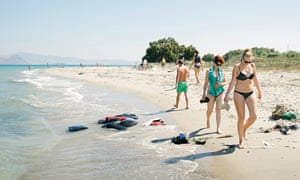
    People swim. They lounge on the beach. They shower with their tops off. They paddle about in the sea. They watch other people doing the same thing. Jörg Brüggemann’s series of photographs from the Greek island of Kos is titled Tourists V Refugees, but in most of the images it’s difficult to tell the difference.

    Tourists walk along a beach in Kos
    Tourists on a beach on Kos pass refugees’ lifejackets. Photograph: Jörg Brüggemann/Ostkreuz

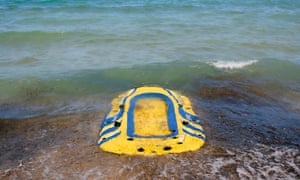
     The paddlers could be holidaymakers – or they might be Syrians coming from Turkey. The ferry might hold tourists or, as is actually the case, hundreds of refugees waiting for their paperwork to be processed so they can proceed to mainland Greece. A submerged dinghy might belong to kids on their summer break. But what if it was steered all the way from Bodrum by Iraqis? Similarly, the lifejackets that appear, discarded, in many of the pictures – it’s likely they each saved a refugee’s life as he or she made the night-time journey from the Turkish coast. But it’s just as plausible that they simply fell off a jetski.

    Approximately 200,000 refugees, mainly from Syria, Iraq and Afghanistan, have arrived on islands such as Kos so far this year, taking flimsy inflatable boats through the darkness from the Turkish coast. This week, photographs of three-year-old Aylan Kurdi washed up on a Turkish beach sparked horror and fierce political debate, after the dinghy in which he, his mother and brother were travelling capsized soon after they set out to reach Kos. This summer much press coverage has focused on the creation of a supposedly unbridgeable chasm between refugees and unsuspecting tourists in places like Kos. The title of Brüggemann’s series certainly sets up this adversarial relationship: tourists versus refugees; good foreigners versus bad ones. But as the pictures show, the reality is not so clearcut.

    As part of my reporting on the European migration crisis for the Guardian, I visited the islands of Kos and Lesbos earlier this summer. I expected to find an insurmountable culture clash. Certainly, these islands are witnessing a refugee crisis. The cash-strapped Greek government, unable to contain its own economic crisis, cannot respond effectively to a migration one. It cannot feed, house or provide paperwork in a timely fashion to the refugees (and that is the fairest description, since these arrivals come mostly from refugee-producing countries). As a result, thousands are stuck in limbo, unable to leave the islands until they’re given a particular document by the Greek police. Many sleep on the streets or in tents. Just west of Kos town, the abandoned hotel Captain Elias has become a makeshift shelter for hundreds of migrants: men, women and children who have no electricity and, until recently, no running water or toilets. In a nearby hotel, a similar number of tourists lie on sun loungers or splash in the pool.

    There have been confrontations. In mid-August, Syrians rioted after they were locked inside an old, dilapidated stadium in Kos town without access to water, toilets or shelter from the heat. Just next door to the stadium stood an open-air cinema where film-goers carried on watching Pierce Brosnan’s latest offering. You could hear the soundtrack over the wall.

    refugees' abandoned dinghy on Kos
    A dinghy abandoned after making the journey from Turkey. Photograph: Jörg Brüggemann//Ostkreuz

    Yet many tourists who had been staying on the island throughout the period said they had barely been aware of the clash. “It hasn’t really affected us,” Val Turewicz, a 34-year-old Polish pharmaceutical executive, told me. “We’ve had no problems.” Across the road, a queue of Afghans and Pakistanis waited outside the police station for documentation.

    In fact, watching tourists as they cycled along the bike path that lines the shore, most seemed oblivious to what was going on around them. Brüggemann captures this dynamic well, with his photograph of a young westerner in a white T-shirt, carrying a selfie stick as he walks past some refugees. He looks as if he hasn’t even noticed them; his holiday continues. To some, such an image might represent a wider lack of compassion for people fleeing unimaginable hardship. Personally, I see something more hopeful. We are told that this wave of migration will shake the foundations of Europe, but myopic tourists suggest something different: they tell us that life goes on.

    In fact, some tourists have actively tried to help. The Dutch tourist pictured here used his two-week holiday in Kos to help distribute food to refugees at the Captain Elias hotel. He joined a group led by hotel owner Reinhilde Michalakopoulos, pictured here delivering peaches. A German who moved to Kos in 1989 to join her Greek husband, Michalakopoulos runs the Kos Palace hotel with her son. In between organising Greek dancing nights and handing out shots of ouzo to guests, she distributes bread from her hotel kitchens and peaches bought from the market to the refugees. Many tourists who stay at her hotel leave behind money, clothes and toiletries, to be redistributed with their blessing.
    Hers is just one of a number of similar groups on Kos and Lesbos. In the south of Lesbos, Greek volunteers run a makeshift camp called the Village of Altogether. In the north, an Australian, Melinda McRostie, serves fish to tourists at the front of her restaurant; at the back, she runs a camp for refugees, handing out food that is often donated and distributed by tourists. Sabine Fischer, a German nurse, told me she wasn’t aware of the refugee influx before arriving on the island, but decided to help McRostie once she saw the situation. “I’m here, I don’t have to do any work,” said Fischer. “I can help.”

    There’s another kind of crossover in places such as Kos and Lesbos. Many Syrians sleep in the streets of Kos, a supposed blight on its tourism industry. But the wealthier ones are staying in its hotels, helping to prop them up. A Syrian I met in northern Greece summed up this irony: he had just walked from the last hotel before the Macedonian border, a place that was on the verge of closure before Syrians started coming this way late last summer. “We bring foreign money into Greece,” said Hamza, an English literature graduate from Damascus. “Every day a thousand people arrive from Syria and Iraq, and they all probably spend $200 here in total – and that’s a lot of money.”
    For the hotel owners, this kind of money means little if tourists stop coming. The mayor of Kos says that, despite the furore, tourism has not yet been affected. But the holiday season will wind down within two months, whereas the refugees are likely to keep coming throughout the autumn. If they do, it will be left to the locals to help feed them; the tourists will have returned home.

    https://www.youtube.com/watch?v=mpxz8Pf2VNE  


    Thursday, 3 September 2015

    Halal Tourism

    http://www.halaltourismconference.com/

    International Halal Tourism Conference comes to Istanbul


    Istanbul will discuss halal tourism in the beginning of December, where more than 1,000 attendees will come together in the city for the second annual International Halal Tourism Conference. Industry and sectoral professionals are expected to formulate new strategies concerning the $150 billion sector


    The concept of halal tourism, which concerns nearly 1.5 billion Muslims all over the world, is the fastest growing trend of global tourism. Many conferences have taken place in different countries to better introduce the concept of halal tourism and attract more people and interest. The second annual International Halal Tourism Conference, a three-day event that was initiated by CM Media under the sponsorship of the Culture and Tourism Ministry and Turkish Airlines, will be held from Dec. 1-3 at the Istanbul Lütfi Kirdar Congress & Exhibition Center (ICEC).

    The event is expected to bring together the global tourism industry and sectoral professionals to discuss strategies on how to tap into this niche market. The conference will be crucial for professionals who are actively engaged in the sector or seeking ways to operate in this market. More than 1,000 international delegates from 30 countries, including industry experts, international speakers, specialists and tourism suppliers are expected to attend the International Halal Tourism Conference.

    According to MasterCard-Crescent Rating Global Muslim Travel Index (GMTI) 2015 data, which is regarded as the most comprehensive research that has been conducted on the sector, the global halal tourism market totaled $150 billion and experienced 14 percent growth last year with 108 million Muslim travelers representing 10 percent of the global travel economy. This number is predicted to grow to $200 billion by 2020. While countries such as Saudi Arabia, Malaysia, Turkey and the United Arab Emirates are prominent actors in this sector, many more countries, regardless of their religious majority, are trying to attract Muslim tourists from all over the world by offering them facilities in accordance with their religious beliefs.

    Halal tourism provides holidays to Muslim travelers, according to the teachings of Islamic Sharia. It offers many different services including flights to different destinations where alcohol or pork-free products are served, hotels serving halal food that is slaughtered in accordance with the teachings of Islamic law, the announcement of prayer times, gender segregated swimming pools and spa facilities, private holiday villas with high walls and religious programs are included in the onboard entertainment.

    The first international conference on halal tourism that took place in Europe was held in Spain last year with the attendance of more than 400 delegates. Turkey will also host another crucial event for the halal sector next year. Organized by Sakarya University and the Saudi Arabia International Islamic Trade Finance Corporation (ITFC), the second International Halal Market Economy conference will be held from March 6-7, 2016. While financial aspects of the Halal Market had been discussed at last year's event, next year's symposium will focus on the halal clothing market. The conference aims to increase halal sensitivity about Muslim's clothes, encourage investments in the sector in Muslim countries and establish new strategies to better promote halal clothing among the Muslim population. Abdullah bin Ahmed er-Rumeyh from El-Kassım University's Faculty of Islamic Studies will chair the conference's supervising council board.Furthermore, the first halal cruise, which caters to Muslim travelers, was launched in Turkey by Antalya-based Fusion Tours at the beginning of August. On the company's September voyage to neighboring Greece, there will be no alcohol, no pork products and no gambling. Also, everything onboard will be in accordance with Islamic religious values, including gender segregated sports centers, single-sex spa facilities, separate Turkish baths and prayer rooms

    http://www.dailysabah.com/life/2015/09/03/international-halal-tourism-conference-comes-to-istanbul 

    Global governments and tourism boards identify the potential of the Halal tourism market
    Three day free-to-attend Summit & Exhibition takes place from 19th – 21st October 2015 at ADNEC, Abu Dhabi
    The World Halal Travel Summit (WHTS15) is exclusively supported by The Abu Dhabi Tourism and Culture Authority

    Palestine, Thailand, Indonesia and Sri Lanka are the latest countries to commit to The World Halal Travel Summit & Exhibition, joining Malaysia, Turkey, UAE, Canada, Australia, Croatia, Egypt, Tanzania and many more who are exhibiting and sponsoring at the event.

    Andy Buchanan, Director, WHTS15 stated “The unrivaled support the summit is receiving on the global stage from the Abu Dhabi Government means that so many leading tourism organisations feel so enthusiastic about participating in the inaugural event. We are delighted to announce that Palestine has a large and important presence at WHTS15 which demonstrates not only how important they feel being part of the summit is but is also a testament to their future tourism ambitions in this space“.
    The World Halal Travel Summit & Exhibition, taking place in Abu Dhabi from the 19th to 21st of October 2015, is an all encompassing networking, educational and business event, putting Halal travel buyers and influencers directly in touch with companies and countries looking to grow their market share in the Halal tourism arena. WHTS15 offers a unique opportunity for exhibitors to meet international key decision makers and buyers, all in one place at one time.
    Milanka Gajanayake, Director General of Sri Lanka Tourism Promotion Bureau commented on their country participation: “Sri Lanka is a tourism world leader and increasing arrivals via Halal tourists is an important component to us achieving our future tourism goals. We are delighted to exclusively partner WHTS15 in Abu Dhabi and look forward to highlighting our country to the world’s senior Halal tourism buyers”.
    Confirmed exhibitors include: Sheikh Zayed Grand Mosque, Shurooq, HMH Hotels, Etihad, Emirates Palace, Premiere Group, Landmark Hotels, Mawasim Tourism & Holidays, Jannah Hotels, R Hotels and many more.
    “Shurooq is participating in WHTS15 to demonstrate the social, cultural, environmental and economic potential of Sharjah to accommodate Halal tourism and to direct new investment into this booming niche sector.” said H.E. Marwan bin Jassim Al Sarkal, CEO of Sharjah Investment and Development Authority (Shurooq).
    To enquire about participating in the World Halal Travel Summit & Exhibition please contact Andy Buchanan, Director, or Shelly McDonald, Marketing Director, on +971 4 360 3109 or via andy@cactievents.com, shelly@cactievents.com or www.whtsexpo.com
    About The World Halal Travel Summit & Exhibition:
    Exclusively supported by the Abu Dhabi Tourism and Culture Authority and taking place in Abu Dhabi from the 19th to 21st of October 2015, WHTS15 is a unique opportunity to network with 6,000 OIC travel agents, hospitality groups, hoteliers, developers, investors and key decision makers from the booming Halal tourism market.
    The Halal travel and tourism market is:
    • Growing at 100% faster than any other niche travel sector
    • Currently representative of $135 billion of outbound bookings
    • Independently forecast to grow to $200 Billion by 2020
    • A substantial generator of immediate and long-term business with maximum revenue
    WHTS15 is designed to match trade buyers with leading brands operating in the Halal travel sector, offering exhibitors and visitors an exclusive, all-encompassing Halal tourism business generation opportunity, in addition to high-level networking with:
    • Travel agent buyers from up to 57 OIC countries
    • 6,000 tourism trade buyers
    • VIP & Ministerial delegations
    • 100’s of exhibitors
    Contact Andy Buchanan, Director, on andy@cactievents.com or Shelly McDonald, Marketing Director, on shelly@cactievents.com or visit www.whtsexpo.com for further information.

    © Press Release 2015

    http://halalfocus.net/uae-the-world-halal-travel-summit-exhibition-abu-dhabi/

    Wednesday, 12 August 2015

    GCC tourists stealing, cooking ducks in Europe!

    Khaleejtimes.com: Mustafa Al Zarooni/Dubai
    Filed on August 12, 2015 | Last updated on August 12, 2015 at 06.54 am


    The tourists have been seen throwing litter, stealing ducks from parks, setting up bonfires on lake shores, smoking shisha, dancing on folk songs on streets, and squatting under the Eiffel Tower!

    The behaviour of GCC tourists in European countries has not gone down well with the locals there, and has also sparked huge resentment at home.

    The tourists have been seen throwing litter, stealing ducks from parks, cutting and cooking them on video, setting up bonfires on lake shores, smoking shisha, dancing on folk songs on streets, and squatting under the Eiffel Tower!

    Not only did this draw backlash from the European media, it also drew severe criticism among the GCC nationals.

    A number of writers and journalists said the attitude of some Saudi and GCC tourists in Europe caused offended Saudi Arabia, and tarnished the image of the Arab, GCC and Muslim citizens abroad.

    They argued in this context that Austria -- a popular destination for GCC residents -- was right in its decision on reducing the number of tourist visas issued to Saudi and Kuwaiti applicants.

    In an article carried in a Saudi-based Arabic daily, writer Khalaf Al Harbi described this summer as exceptional for the GCC tourists in Europe as they have done what could not be done, and had recorded their brazen attitudes in audio-visual tapes.

    The article said the tourists from the GCC states had danced on the camel folk songs on high-end streets in European cities, stolen ducks from parks, cut and cooked the birds, and shot everything on camera.

    "They put the generous pots on bonfire by the side of the lakes, smoked shisha, and in France they squatted on the ground under the Iconic Eiffel Tower", he wrote.

    This "disgraceful" attitude and behaviour strengthened anti-Arab trends, and might prompt some European states to take actions restricting the influx of GCC tourists, such as Austria, he warned.

    Elaborating, Al Harbi said the parliament of Salzburg in Austria had issued a decision on the basis of a proposal put by MPs, making it mandatory for the government in Vienna to reduce the number of tourist visas granted to the citizens of Saudi Arabia and Kuwait.

    "The parliament also asked the Austrian embassies in Riyadh and Kuwait to provide the visa applicants with booklets explaining the Austrian culture", he recalled.

    In another article titled "Fashaltoona", or "You let us down", a lady journalist Bashaer Mohammed wrote in Al Watan Arabic daily said the behaviour of GCC residents was an attempt to expel the Saudi tourists from Czech Republic, and make it binding on the embassy, according to some media outlets, to reform what had been spoilt by its citizens.

    "I blamed the Czechs for not imposing strict restrictions on Saudi tourists from the beginning, for littering parks and playgrounds and messing the public places," she held.

    "The Saudi who demanded the building of parks and playgrounds in his home country is, in fact, he who destroys them and re-demanded the setting up of the same," she said, and this was a testimony of the countries where he -- the Saudi tourist -- holidays in, be it the Czech Republic or any other country."

    Members who frequented the social networking websites stressed on the importance of building what they termed as a cultural thought aiming at respecting others, respecting public places irrespective of the region.

    "We as GCC citizens have become, in the eyes of some Europeans, as violators of animal and environment rights, needless to say as brutal as some others have dubbed us, after some GCC youths had stolen ducks from lakes, cooked and ate the birds, as if they did not find something to devour," wrote Maisa Rashid Ghadeer.

    Municipalities in some European countries have, in reaction to these rowdy attitudes, recommended increasing the prices of accommodation for GCC tourists, and reduce the quota of visit visas.

    Monday, 10 August 2015

    Some 200 people protest against Arab spa-goers in Teplice

    25-07-2015 13:50 | Jan Velinger Around 200 people took part in a demonstration at a popular park in Teplice on Friday to protest against the presence of visitors from Arab countries who vacation at the local spa resorts or have bought property in the area. Many of the protestors brought their dogs, charging that the park had been taken over by the foreigners, and accusing them of leaving areas in "disarray" or of behaving inappropriately. The event was attended by politician Tomio Okamura as well as members of anti-Islam initiatives and even members of extremist groups, sources reported. Some opponents of the demonstration, such as Teplice councillor Dominik Feri, have called for a constructive dialogue on the issue and for locals to "not allow themselves be manipulated by extremists".


    MfD: Arabs cleaning town to have good relations with Czechs


    Prague, Aug 7 (CTK) - The Arabs staying in the spa of the Teplice, north Bohemia, are cleaning up the local area to ease the tension between them and local residents, daily Mlada fronta Dnes (MfD) writes Friday.
    This week, the Arabs staged the second cleaning of the Sanovsky park in which they often practice picnicking, MfD writes.
    In recent weeks, some Teplice residents protested against the Arabs making disorder in the area.
    The "act of reconciliation" is to repeat, MfD writes.
    In addition, picnics at which the Arabs are to make friends with locals are to be staged, it adds.
    "We want Teplice residents to learn the culture of the spa guests and vice versa," organiser Eman Ghaleb, a 17-year girl born in Yemen, who has been living in Teplice since 2003, told the paper.
    "This will prevent further misunderstandings," Ghaleb said.
    Football pitches are to be leased so that the children of the Middle East visitors do not threaten people walking in the park by their playing football, MfD writes.
    "We will insist on the maintenance of order and night calm, asking the spa guests to follow suit," Ghaleb said.
    The relationships between the spa guests from the Middle East and the Teplice residents are being dealt with not only in the streets and social networks, but also on the diplomatic level, MfD writes.
    Earlier this week, ambassador of Kuwait Ayman Muhammad Al-Adsani agreed with Teplice officials on continuing the practice that proved well last year already, it adds.
    "We will pass again information on the clients who breach the rules in Teplice to the Kuwaiti side," Deputy Mayor Hynek Hanza has told the paper.
    "They can expect punishment back in Kuwait," he added.
    "They were fined in Teplice and after their return to Kuwait, they were stripped of their driving licences. Kuwaiti authorities even restricted further travels abroad to some of them," Hanza said.
    Copyright 2015 by the Czech News Agency (ČTK). All rights reserved. http://praguemonitor.com/2015/08/10/mfd-arabs-cleaning-town-have-good-relations-czechs 

    Czech town tries to smooth out relations with Arab guests


    A Czech spa town is trying to heal rifts between Arab guests and the local community after misunderstandings on dogs, noise complaints and a failed burqa ban soured relations.
    Thousands of Arabs patients come to live in the town for several weeks or months during the season, often with family members in tow.
    But in recent years, tensions have risen between perceived differences between the cultures and style of living of locals and the spa guests from the Gulf states - with particular complaints about rubbish left in the park, noise at night and a lack of respect for a Czech's best friend: the dog.
    Volunteers from the local Islamic community - mostly doctors and spa workers - have taken it upon themselves to try to heal the tensions by distributing information leaflets.
    Volunteer, Dr. Mohammed Ghaleb: "The dog is part of the family in the Czech Republic and so we wrote in the leaflet what it means - like when you hurt the dog it is like when you hurt someone in the family. They didn't know that. So we inform them this way."
    The leaflets are also stuck into the shop windows of the Arabic markets. Ghaleb's daughter, Imman, said that she believes they are getting their message across.
    Volunteer Imma N Ghaleb: "The main effect which our effort has is that the people note this and that they speak about it during their picnics. When they see us, they know who we are and what our aim is."
    But the amount of rubbish still building up in the park despite regular cleaning and the volunteers has reached an unacceptable stage, says the town hall. It plans to introduce a spa fee of about EUR 0,60 per person a day to cover the increased costs for cleaning the city. 
    http://uatoday.tv/society/czech-town-tries-to-smooth-out-realtions-with-arab-guests-479946.html 

    Sunday, 26 July 2015

    Saudi king arrives on French Riviera amid uproar over beach closure


    © Valery Hache, AFP | General view of the public beach called "La Mirandole", located below a villa owned by Saudi King, on July 20, 2015 in Vallauris, southeastern France

    france24.com - King Salman of Saudi Arabia arrived in France on Saturday for a Riviera holiday, with the closure of the beach in front of his villa incensing local residents.


    While the king's three-week visit with an entourage of nearly 1,000 is a boon for the local economy, theclosure of a public beach for the privacy and security of the royal party -- along with illegal construction work -- has sparked anger.
    Authorities brought forward the closure of the kilometre (half a mile) stretch of beach to early on Saturday to prevent an occupation of the area beforehand.
    Two Saudi Arabian Airlines Boeing 747s arrived on Saturday evening at Nice airport with King Salman and his entourage on board.
    They then headed to the private villa in Vallauris, on the Riviera between Antibes and Marseille.
    The king's inner circle will be put up at the family's private villa, while some 700 other members of his entourage will be accommodated at top hotels on the promenade in Cannes.
    Hundreds of other Saudis will be following the king on his holiday -- as is the tradition -- swelling the total number of Saudi citizens flooding into the southern French beach resorts.
    "Clearly this is good news," Michel Chevillon, president of an association representing hotel managers in Cannes, said earlier this week.
    "These are people with great purchasing power which will pep up not only the luxury hotel industry but also the retail and tourism sectors of the town," Chevillon said.

    Royal 'messing around'
    But not everyone is happy.
    Beach access is normally open in France as it is the state that owns the coast, and tensions often flare when towns close them off partially by granting concessions to firms offering rentals of parasols and sunbeds.
    More than 100,000 people have signed a petition protesting the "privatisation" of the beach in front of the Saudi king's villa.
    "We recall that this natural zone, like all maritime public estates, is an intrinsic public property that should be available for the benefit of all, residents, tourists, French, foreigners or people passing through," the petition said.
    "We ask the state to guarantee the fundamental principle of the equality of all citizens before the law," the text added.
    French authorities may close off beach access for security reasons, however.
    A ban on approaching closer than 300 metres (yards) of the villa by sea goes into effect on Saturday.
    Illegal construction work by the villa has also poisoned the atmosphere.
    Workers had tried to install a fence to close access to the beach during the king's arrival, but local authorities intervened and it was removed, as was a metal catwalk bolted to the rock cliffs upon which the villa sits.
    A cement platform was also poured on the beach for an elevator up to the villa. Local authorities acquiesced on condition the elevator is removed after the visit.
    "We're sick and tired of this messing around," a local woman said ahead of the visit.
    "I can see it's normal that you need to guarantee their security, but they should let us go for a swim."
    (AFP)

    The Saudi King's unpopular requirements garnered widespread media attention

    Monday, 18 May 2015

    All it needs is love: Abandoned Indian ashram where Beatles wrote 48 songs and went on spiritual journey is set to be resurrected as tourist attraction

  • The retreat where the Fab Four learned meditation from Maharishi Mahesh Yogi has been derelict for years
  • George Harrison, John Lennon, Paul McCartney and Ringo Starr visited the ashram in India in 1968
  • While they were passing the time at the ashram they penned around 48 songs, including Back In The USSR

  • By TED THORNHILL FOR MAILONLINE

    It's where The Beatles wrote 48 songs and learned how to meditate - and now it's going to be spruced up and turned into tourist attraction. 
    The Indian retreat in the Himalayan foothills where the Fab Four learned transcendental meditation from Maharishi Mahesh Yogi has been derelict for years, but now it's going to be completely renovated.  
    The Beatles visited Maharishi Mahesh Yogi's ashram in Rishikesh in 1968. The visit by George Harrison, John Lennon, Paul McCartney and Ringo Starr involved them staying in the now derelict igloo shaped Chaurasi Kutia huts in the ashram.

    The Indian retreat in the Himalayan foothills where the Fab Four learned transcendental meditation from Maharishi Mahesh Yogi has been derelict for years
    The Indian retreat in the Himalayan foothills where the Fab Four learned transcendental meditation from Maharishi Mahesh Yogi has been derelict for years

    The visit by George Harrison, John Lennon, Paul McCartney and Ringo Starr involved them staying in the now derelict igloo shaped Chaurasi Kutia huts in the ashram
    The visit by George Harrison, John Lennon, Paul McCartney and Ringo Starr involved them staying in the now derelict igloo shaped Chaurasi Kutia huts in the ashram
    The Beatles visited Maharishi Mahesh Yogi's ashram in Rishikesh in 1968. It's been a pilgrimage for Beatles fans ever since
    The Beatles visited Maharishi Mahesh Yogi's ashram in Rishikesh in 1968. It's been a pilgrimage for Beatles fans ever since

    The Beatles  with the Maharishi Mahesh Yogi in 1968
    The Beatles with the Maharishi Mahesh Yogi in 1968

    The property was allowed to go derelict but now the Uttarakhand government is planning to renovate the rundown ashram, which is nestled in the Himalayan foothills, in a bid to promote ecotourism.
    The project will include a small museum which will show photographs of the Beatles' 1968 visit in a hall of the ashram.
    Neena Grewal, Director of the Rajaji National Park, where the ashram is, said: 'We want to revive the Beatles' connection to the ashram, as a lot of tourists come here because of it. We will restore the huts, as a part of promoting ecotourism in Chaurasi Kutiya. We will submit a detailed proposal to the government soon.'
    Paul Saltzman, a Canadian film director and producer, who stayed at the ashram with The Beatles and has written a book based on those experiences, praised the move: 'It's a brilliant idea for the Uttarakhand government to refurbish the ashram where the Beatles were in 1968. 
    'It makes complete sense to promote eco-friendly tourism in the area, as well as to honour and celebrate, not only the Beatles' visit, but also the impact they had on spreading more news of the value of meditation and yoga to the West.'


    Read more: http://www.dailymail.co.uk/news/article-3086604/All-needs-love-Abandoned-Indian-ashram-Beatles-wrote-48-songs-went-spiritual-journey-set-resurrected-tourist-attraction.html#ixzz3wLklJBIE
    Follow us: @MailOnline on Twitter | DailyMail on Facebook


    Dilapidated: The Satsang Hall in the abandoned ashram which was once home to the Maharishi Mahesh Yogi, spiritual leader to the Beatles


    Friday, 20 February 2015

    'Fertility tourism' struck down by Thai lawmakers. Why now?

    The case of 'Baby Gammy' involving an Australian couple, and a 'baby factory' case where a Japanese businessman fathered 16 children, brought a public outcry. 

    Apichart Weerawong/AP/file

    Thailand's military-dominated parliament has passed a law banning foreigners from paying Thai women to be surrogates, which threatens to push the country’s booming fertility tourism industry underground. The move follows a string of scandals involving Australians and Japanese who hired Thai women to carry fetuses to term.
    The new law actually prohibits all commercial surrogacy in Thailand, but seems especially aimed at stopping local women from becoming "the wombs of the world," National Legislative Assembly member Wanlop Tangkananurak told The Associated Press on Friday.
    But critics warn that the commercial surrogacy ban will only create a black market for the practice, making it harder for couples to access quality physicians and medical care.
    Recommended: Protests and coups: Is Thailand still the 'land of smiles?' Take our quiz.
    Rampant corruption and lax law enforcement in Thailand has long fueled a thriving underground economy that trades in everything from illicit drugs to endangered animals.
    Thailand began drafting a law on commercial surrogacy nearly five years ago. But successive political crises stalled its progress until last year, when the country was rocked by two major surrogacy scandals.
    The first involved an Australian couple who left behind a twin boy, known as Baby Gammy, with his surrogate mother after they discovered he had Down syndrome. Then came the revelation that a Japanese businessman had fathered at least 16 babies via Thai surrogates in a case later dubbed “the baby factory.”
    Both cases ignited widespread public outrage that pushed the Thai government to act. On Thursday, the parliament voted 160 to 2 to pass the law banning commercial surrogacy.
    While the new law prohibits foreign and same-sex couples from seeking surrogacy services in Thailand, Australian Associated Press reports, it does allows married heterosexuals with at least one Thai partner to use surrogates. Legal surrogates must be Thai, over 25 years old, and may not accept payment. 
    The law states that anyone involved in illegal commercial surrogacy will face a maximum jail term of 10 years and a maximum fine of 200,000 baht ($6,100), the AP reports.
    Fertility tourism across the world has been growing steadily over the last decade. Global IVF, an online resource guide for fertility tourists, estimates that 6,000 babies were born last year via overseas surrogates.
    Western couples in search of low-cost alternatives to surrogacy in their home countries have largely contributed to the industry’s growth. In the United States, surrogacy is heavily regulated and can cost upward of $100,000 depending on the types of services and the clinic. In some states, commercial surrogacy is explicitly prohibited.
    By contrast, surrogacy services in Thailand cost a fraction of that amount –closer to $40,000, according to The Washington Post – which could potentially make the risk of defying the law worth it for some couples.
    As the BBC’s Jonathan Head reports:
    The yearning of childless couples for babies will now probably move on to less regulated countries. But will surrogacy end in Thailand? The money to be made is so tempting for poor families that the business may still survive as an underground, illegal one, with all the dangers to the women of exploitation and poor health facilities.
    As one of few Asian countries where commercial surrogacy was not specifically outlawed, Thailand has been a go-to destination for couples from Australia, Hong Kong, and Taiwan.
    But there is no shortage of fertility tourism destinations willing to absorb couples in search of legal alternatives. Aside from Bangkok, cities fromKolkata to Cancun have emerged as global fertility hubs in recent years 
    www.csmonitor.com